

Knowing the chords is only half of accompanying. The other half is rhythm: what the left hand does with the bass, what the right hand does with the chord, and how the two lock together. A song can use the same four chords as a hundred others and still sound like a ballad, a disco track or a bossa nova purely because of the pattern. This guide walks through the 13 patterns in ChordGrind's free Piano Accompaniment Patterns trainer, explains what makes each style tick, and gives you a routine for getting them into your hands in every key.
Table of Contents
- What Is a Piano Accompaniment Pattern?
- The Left Hand: Roots, 5ths, Octaves and Walking Lines
- The Right Hand: On the Beat, Off the Beat, and Pushes
- Pop & J-Pop Patterns
- Funk & Disco Patterns
- Bossa Nova Patterns
- Jazz Patterns
- How to Use the Accompaniment Trainer
- A 4-Week Routine
- Common Mistakes
- FAQ
What Is a Piano Accompaniment Pattern?
An accompaniment pattern is a rhythm for each hand, repeated bar after bar while the chords change underneath. The left hand usually covers the bass — the root of each chord, plus 5ths, octaves or passing notes. The right hand plays the chord itself, as a voicing struck on particular beats.
Every pattern in the trainer is a 4-bar drill over a 4-chord progression, so one pass is one complete loop of the chords. Once it's steady in one key you move it to the next — a pattern you can play in all 12 keys is one you really own.
The Left Hand: Roots, 5ths, Octaves and Walking Lines
Most bass parts are built from a small set of notes:
- Root (1) — the chord's name note. Always safe, always on beat 1.
- 5th above or below — root–5th rocking is the backbone of pop and country; root–low 5th is the bossa nova and jazz two-feel sound.
- Octave (8) — root–5th–octave–5th broken patterns fill out ballads; bouncing octaves drive disco.
- 3rd and 10th — a 3rd adds motion in walking lines; a 10th (a 3rd an octave up) is a big, warm stretch.
- Chromatic approach — a note a half step above or below the next chord's root, played on the last beat to lead into it. This is what makes a walking bass walk.
The Right Hand: On the Beat, Off the Beat, and Pushes
The right hand's job is to place the chord. Three ideas cover almost everything:
- On the beat — chords on 1, 2, 3, 4. Solid but plain.
- Off the beat — chords on the "ands" between the bass notes. This is the first real step to hand independence: the hands alternate instead of striking together.
- Pushes (anticipations) — the next chord arrives a sixteenth or an eighth early, tied over the bar line. Pushes are what make pop and bossa grooves feel like they're leaning forward.
Pop & J-Pop Patterns
| Pattern | Level | Feel | Progression | What it trains |
|---|---|---|---|---|
| Pop Off-Beat Eighths | 1 | straight | I–V–vi–IV | Quarter-note bass, chords on every "and" — the simplest independence drill |
| Pop Shuffle | 1 | swing | I–vi–IV–V | Root–5th rocking in swung eighths |
| Triplet Ballad (12/8 Feel) | 1 | swing | IV–V–iii–vi | A held chord answered by its top note, bass rising root–5th–octave |
| Pop 16th Syncopation | 2 | straight | I–vi–IV–V | Dotted-eighth and tied-sixteenth chords over a held root |
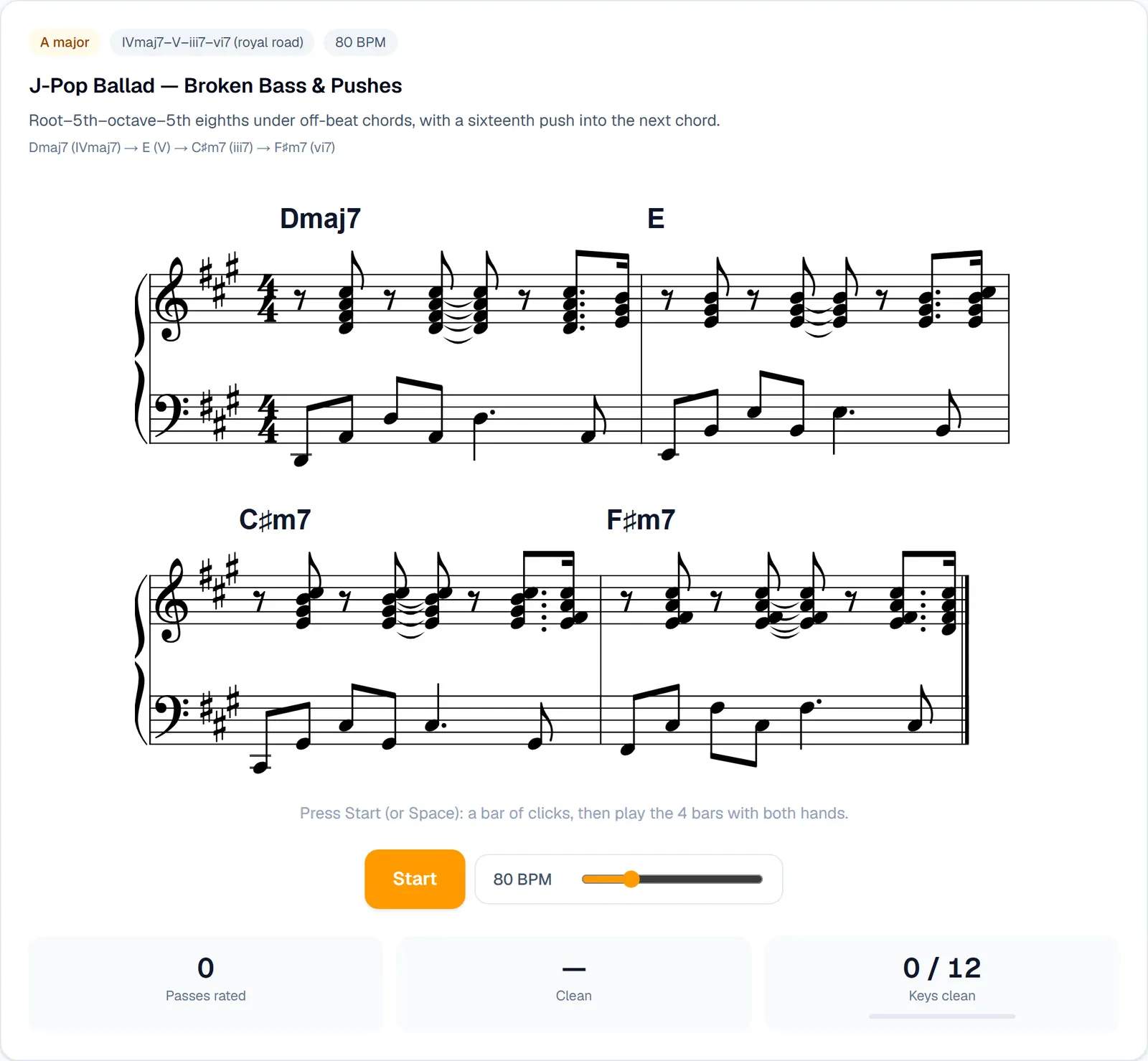
| J-Pop Ballad — Broken Bass & Pushes | 2 | straight | IVmaj7–V–iii7–vi7 | Root–5th–octave–5th eighths, off-beat chords, a sixteenth push into each bar |
| J-Pop 16-Beat Drive | 3 | straight | vi–IV–V–I | A driving sixteenth bass that steps a half step into each chord |
The J-Pop Ballad uses the "royal road" progression (IVmaj7–V–iii7–vi7, ōdō shinkō) heard all over Japanese pop and anime songs. If you want more songs that use these progressions, the Chord Progressions in All 12 Keys guide lists examples for each one.
Funk & Disco Patterns
| Pattern | Level | Progression | What it trains |
|---|---|---|---|
| Disco Octave Bass | 2 | vi7–ii7–V7–Imaj7 | Bouncing dotted-eighth octaves sliding into each chord; short sixteenth stabs on top |
| Funk Dominant Vamp | 2 | I13–IV13 | 13th-chord stabs around a bass that anticipates beat 2 |
| Funk 16th Stabs | 3 | ii9–V13 vamp | Clavinet-style sixteenth stabs over a sparse bass |
Funk is about space: short, dry right-hand stabs with silence between them, and a bass that plays fewer notes but in exactly the right places. Keep the stabs short — let go of the keys as soon as you hit them.
Bossa Nova Patterns
| Pattern | Level | Progression | What it trains |
|---|---|---|---|
| Bossa Nova Basic | 2 | ii7–V7–Imaj7 | The two-bar 3-3-2 / 2-3-3 comping figure over a root–low-5th bass |
| Bossa Nova with Anticipations | 3 | iii7–VI7–ii7–V7 | A busier comp that ties over beat 2 and pushes into the next chord |
The bossa nova bass plays root on 1, low 5th on 3, each a dotted quarter followed by an eighth. The right hand plays a two-bar rhythm against it — that's why bossa sounds like it floats: the hands repeat on different cycles.
Jazz Patterns
| Pattern | Level | Progression | What it trains |
|---|---|---|---|
| Jazz Two-Feel with Charleston | 1 | ii9–V13–Imaj9–VI13 | Half-note bass, rootless voicings on 1 and the "and" of 2 |
| Walking Bass with Comping | 3 | ii9–V13–Imaj9–VI13 | Root–5th–3rd–approach walking bass under a comp on the "and" of 2 |
The Charleston rhythm (beat 1, then the "and" of 2) is the first comping rhythm most jazz pianists learn. The right-hand voicings here are rootless — if they're new, learn them with Rootless Voicings for Piano: Type A & B, or start with simpler shell voicings.
How to Use the Accompaniment Trainer
Open Piano Accompaniment Patterns.
- Choose a pattern. Filter by style — Pop & J-Pop, Funk & Disco, Bossa Nova, Jazz — and pick a card. Each shows its level (1–3), whether it's straight or swing, and a suggested tempo range.
- Start in today's key. The key defaults to today's key from your practice plan; pick any of the 12 major keys from Key.
- Listen first. Under Hear, the trainer can play the right hand, the left hand and a click on a sampled piano. Turn one hand off and play that hand yourself while the piano plays the other — then turn both off and play both.
- Press Start (or Space). You get a bar of count-in clicks, then play the 4 bars. The current bar is highlighted on the staff.
- Rate the pass honestly. 1 = Clean, 2 = Shaky, 3 = Fell apart. A clean pass moves you to the next key (After a clean pass: up a 4th, up a half step, or stay); a shaky one keeps you where you are. Choose Loop under Playback if you'd rather repeat the 4 bars without stopping.
- Track your keys. Passes rated, Clean % and Keys clean (of 12) update as you go, and the stats panel shows which keys and patterns are still weak. Sessions are saved in your browser and appear on the Dashboard.
Use the tempo slider freely: start at the bottom of the suggested range and only speed up once you get two clean passes in a row.
A 4-Week Routine
| Week | Patterns | How |
|---|---|---|
| 1 | Pop Off-Beat Eighths, Pop Shuffle | Hands separately with the piano playing the other hand, then together; today's key |
| 2 | Triplet Ballad, Jazz Two-Feel with Charleston | Both hands, Next key up a 4th after each clean pass |
| 3 | J-Pop Ballad, Bossa Nova Basic, Disco Octave Bass | Start at the lowest suggested tempo; aim for 6 keys clean |
| 4 | One level-3 pattern of your choice | All 12 keys, raise the tempo by 10 BPM when a key is clean |
Common Mistakes
- Practising too fast. If a pass "fell apart", the tempo was the problem, not your hands. Drop 10–20 BPM.
- Rating shaky passes as clean. The trainer only moves you on when you say Clean. Be strict — it's what makes the key coverage meaningful.
- Hands always striking together. Most of these patterns alternate the hands. Practise with one hand muted until the other hand's rhythm is automatic.
- Ignoring the swing. Swing patterns are written in straight eighths but played long–short. Listen with Hear on before you play them.
- Staying in C. A pattern you can only play in C is a party trick. Move it through the keys.
FAQ
What is the easiest piano accompaniment pattern?
Pop Off-Beat Eighths: quarter notes in the left hand and chords on every "and" in the right. It teaches the hands to alternate, which every other pattern builds on.
How do I improve left-hand and right-hand independence?
Mute one hand in the trainer and play only the other along with the piano, then swap, then play both. Slow, clean passes build independence faster than fast, messy ones.
What is the bossa nova piano rhythm?
A bass of root on beat 1 and low 5th on beat 3, each a dotted quarter plus an eighth, with a two-bar right-hand rhythm on top (3-3-2 in the first bar, 2-3-3 in the second).
Do I need to read music to use these patterns?
No. The staff helps, but you can also learn each pattern by ear: turn on Hear for both hands, listen for a few loops, then copy it.
Start Practising
A handful of patterns in every key will make any chord chart sound like music. Open the free Piano Accompaniment Patterns trainer, start with Pop Off-Beat Eighths in today's key, and rate every pass honestly. Want richer chords to put into these rhythms? Learn to play 7th chords as triads over a bass note with the Slash Chords for Piano guide, then drill the progressions in the Chord Progression Trainer.