

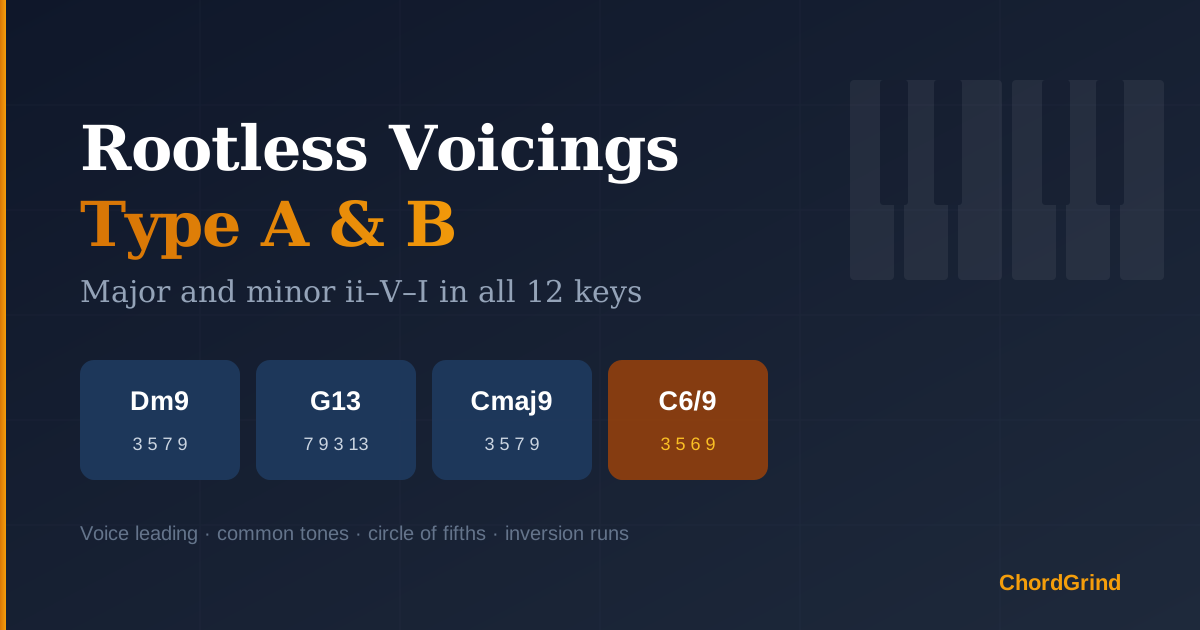
Rootless voicings are the sound of modern jazz piano: four notes, no root, full of 9ths and 13ths, sitting comfortably in the middle of the keyboard. The bass player (or your own left hand on a downbeat) covers the root; your voicing provides the colour. The trick is the Type A / Type B system — two shapes that connect a whole ii–V–I with tiny finger movements. This guide explains both and shows you how to drill them, along with circle-of-fifths chord cycles, in ChordGrind's free Circle of Fifths & Rootless ii–V–I trainer.
Table of Contents
- What Are Rootless Voicings?
- Type A vs. Type B
- The Major and Minor ii–V–I
- How Voice Leading Connects the Chords
- How to Use the Rootless ii–V–I Trainer
- Key Cycle: 7th Chords Around the Circle of Fifths
- A 3-Week Practice Plan
- FAQ
What Are Rootless Voicings?
A rootless voicing leaves out the root and keeps the notes that give a chord its character: the 3rd and 7th (the guide tones) plus colour tones such as the 9th, 13th or 5th. Dropping the root frees a finger for colour and avoids doubling the bass.
If you haven't played shell voicings yet, start there — rootless voicings are built on exactly the same guide-tone motion, with colour tones added around it.
Type A vs. Type B
Every rootless voicing comes in two inversions, named by the note at the bottom of the ii chord:
| Type | ii chord from the bottom | Where the 3rd and 7th sit |
|---|---|---|
| Type A | 3 – 5 – 7 – 9 | 3rd on the bottom |
| Type B | 7 – 9 – 3 – 5 | 7th on the bottom |
Through a ii–V–I the two types alternate: a Type A ii chord leads to a Type B V chord, and so on. Learning both lets you choose the version that sits in the best register for each key — usually somewhere between middle C and the B above.
The Major and Minor ii–V–I
The trainer drills four bars per key:
| Progression | Bar 1 | Bar 2 | Bar 3 | Bar 4 |
|---|---|---|---|---|
| Major ii–V–I | ii m9 | V13 | I maj9 | I 6/9 |
| Minor ii–V–i | iiø7 (m7♭5) | V7alt | i m(maj7) | i m6/9 |
In C major that's Dm9 – G13 – Cmaj9 – C6/9; in C minor it's Dø7 – G7alt – Cm(maj7) – Cm6/9.
How Voice Leading Connects the Chords
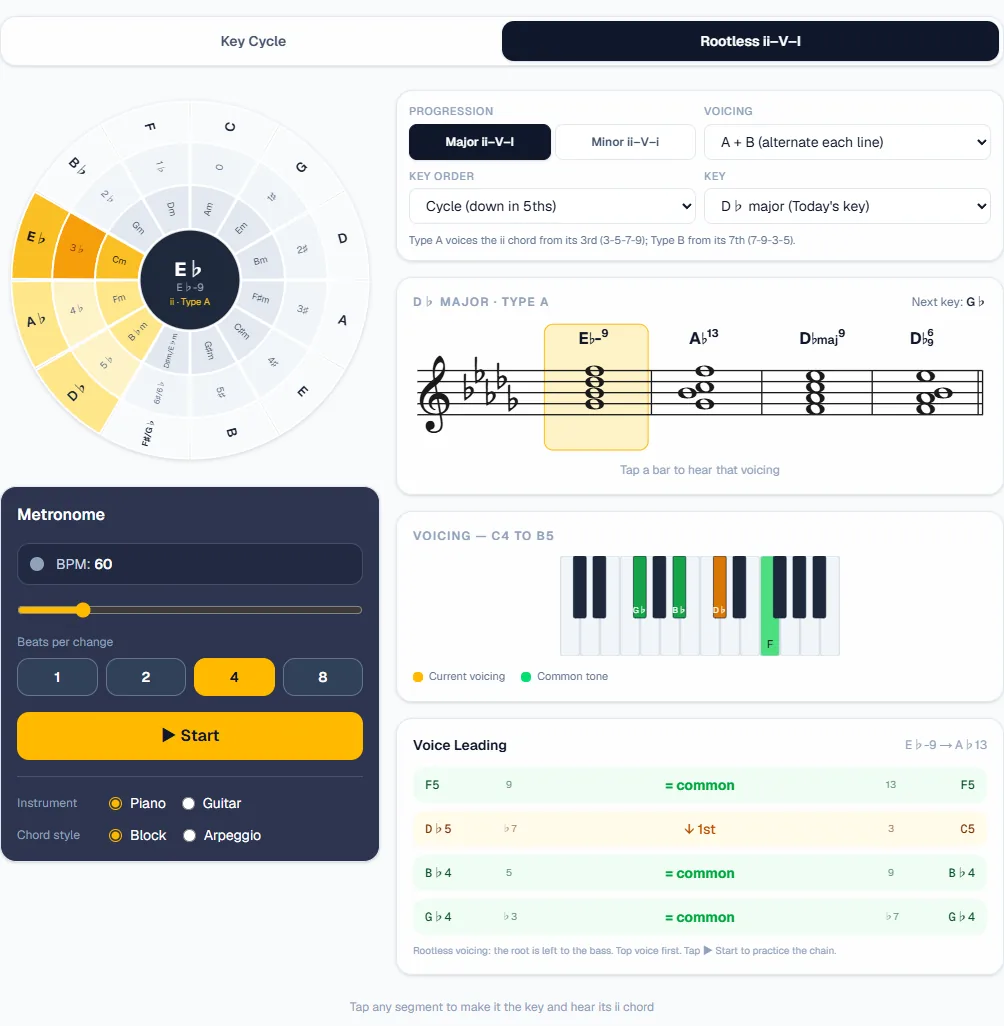
Rootless voicings are designed so most notes stay put between chords and the rest move by a half or whole step. From Dm9 to G13 (Type A to Type B), three of the four notes are common tones and only one note falls a half step — the 7th of Dm9 becoming the 3rd of G13.
How to Use the Rootless ii–V–I Trainer
Open the trainer and switch to the Rootless ii–V–I tab.
- Choose the progression. Major ii–V–I or Minor ii–V–i.
- Choose the voicing. Type A, Type B, or A + B (alternate each line) to play the same key both ways.
- Choose the key order. Cycle (down in 5ths), Cycle (up in 5ths), Random key, or Manual (stay in key). The key defaults to today's key from your practice plan.
- Read the staff and the keyboard. The current bar is highlighted; the keyboard below shows the voicing between C4 and B5 with common tones marked. Tap any bar to hear that voicing.
- Study the Voice Leading table. For each move it lists every voice — which ones stay ("= common") and which ones step and by how much.
- Start the metronome. Set the BPM and Beats per change (1, 2, 4 or 8), pick piano or guitar, block chords or arpeggios, and press ▶ Start to play through the keys with the click. Tap any segment of the circle to jump to that key and hear its ii chord.
Key Cycle: 7th Chords Around the Circle of Fifths
The Key Cycle tab is the warm-up: one chord quality — maj7, 7, m7 or m7♭5 — moving round the circle of fifths, ↓ Down 5ths or ↑ Up 5ths.
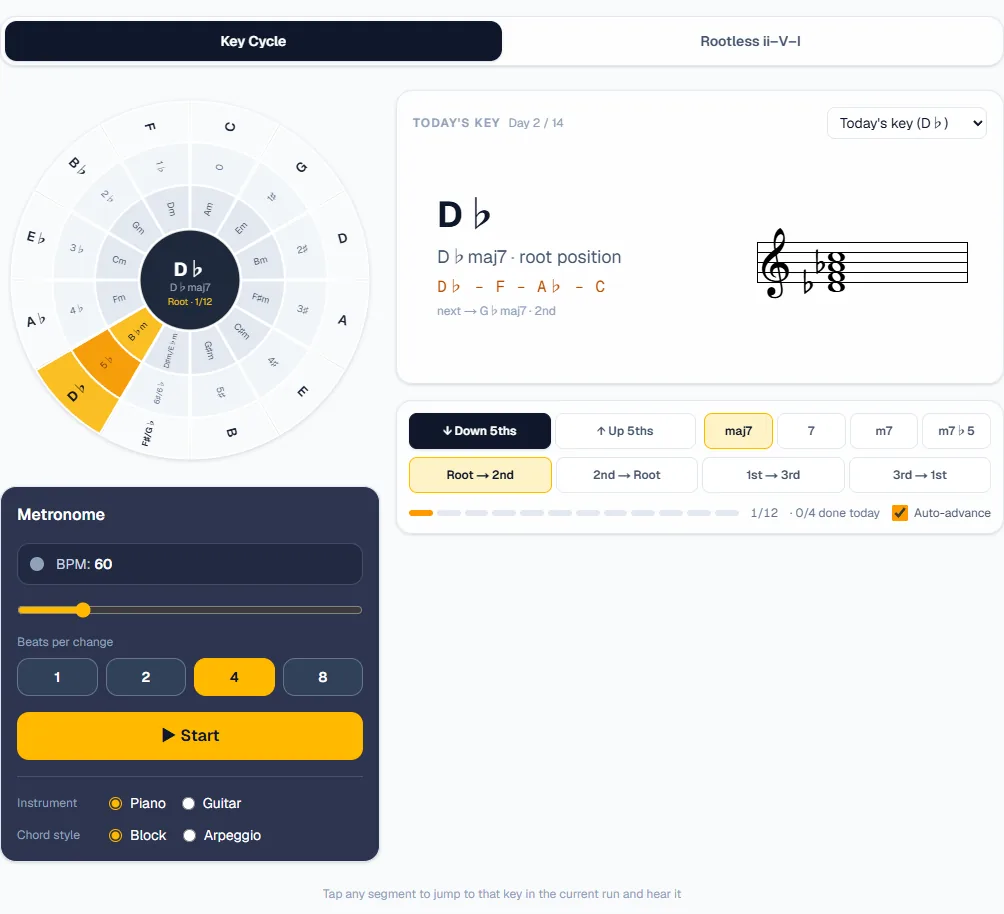
Moving a 7th chord by a fifth leaves two common tones, so if you hold them, the next chord lands two inversions away. The four inversion runs — Root → 2nd, 2nd → Root, 1st → 3rd, 3rd → 1st — each start on a different inversion; play all four and you've covered all 48 voicings (12 keys × 4 inversions) of that chord type. The progress bar counts keys in the current run, and done today counts finished runs. With Auto-advance on, the next key comes with the click.
A 3-Week Practice Plan
| Week | Tab | Settings |
|---|---|---|
| 1 | Key Cycle | m7, then 7, then maj7 — one run a day, 4 beats per change |
| 2 | Rootless ii–V–I | Major, Type A, Cycle down in 5ths, 4 beats per change |
| 3 | Rootless ii–V–I | Major A + B, then Minor A + B, 2 beats per change |
FAQ
Who plays the root if the voicing is rootless?
The bass player — or, solo, your left hand on the downbeat before moving to the voicing. In a trio the rootless voicing usually goes in the left hand while the right plays the melody.
Should I learn Type A or Type B first?
Learn one key in Type A until the shapes are automatic, then the same key in Type B. Alternating A + B in each key is what makes the system useful.
What does "7alt" mean?
An altered dominant: a dominant 7th with altered tensions (♭9, ♯9, ♭5 or ♯5). In the minor ii–V–i it creates strong pull to the minor tonic.
Are these voicings only for jazz?
They come from jazz, but neo-soul, gospel and modern pop keyboard players use the same rich ii–V–I sounds.
Start Practising
Rootless voicings take a few weeks to settle in, and then every chart sounds better. Open the free Circle of Fifths & Rootless ii–V–I trainer, start with Type A in today's key, and follow the common tones. For a lighter starting point, drill shell voicings first.