

Most songs are built from a handful of chord progressions. I–V–vi–IV, I–vi–IV–V, vi–IV–I–V — learn those in every key and you can accompany a huge share of pop music by ear, transpose for any singer, and read chord charts at sight. This guide explains how to think about progressions in numbers rather than letter names, and gives you a routine to drill them with ChordGrind's free Chord Progression Trainer.
Table of Contents
- Why Learn Progressions in Numbers?
- Roman Numerals vs. Nashville Numbers
- The Progressions Worth Learning First
- How to Use the Chord Progression Trainer
- A 4-Week Routine
- Common Mistakes
- FAQ
Why Learn Progressions in Numbers?
"C – G – Am – F" is one song in one key. 1 – 5 – 6m – 4 is that same song in every key. Thinking in scale degrees is what lets keyboard players transpose instantly: change the key, keep the numbers, and the shapes under your hands follow.
It also trains your ears. Once you know what 4 – 5 – 6m sounds like, you'll start recognising it in songs before you've looked at a chart.
Roman Numerals vs. Nashville Numbers
Both describe chords by their position in the key:
| Degree | Roman numeral | Number | In C major | In G major |
|---|---|---|---|---|
| 1 | I | 1 | C | G |
| 2 | ii | 2m | Dm | Am |
| 3 | iii | 3m | Em | Bm |
| 4 | IV | 4 | F | C |
| 5 | V | 5 | G | D |
| 6 | vi | 6m | Am | Em |
Roman numerals use upper case for major and lower case for minor. The number system (popular with session players) writes minor chords as "6m". Use whichever your band or teacher uses — the trainer shows both.
The Progressions Worth Learning First
| Progression | Numbers | In C |
|---|---|---|
| I – V – vi – IV | 1 – 5 – 6m – 4 | C – G – Am – F |
| I – vi – IV – V | 1 – 6m – 4 – 5 | C – Am – F – G |
| vi – IV – I – V | 6m – 4 – 1 – 5 | Am – F – C – G |
| I – vi – ii – V | 1 – 6m – 2m – 5 | C – Am – Dm – G |
| IV – V – iii – vi | 4 – 5 – 3m – 6m | F – G – Em – Am |
How to Use the Chord Progression Trainer
Open the Chord Progression Trainer.
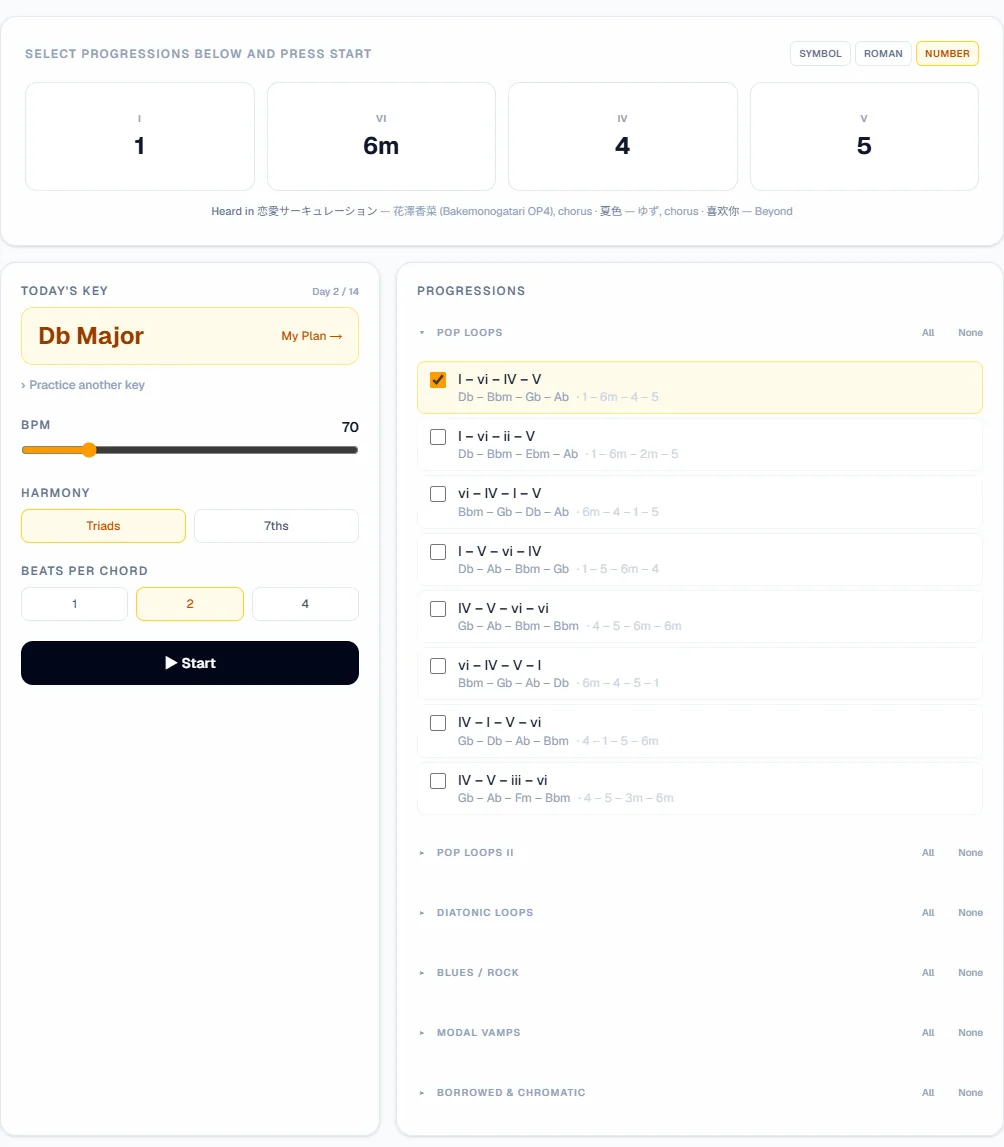
- Start in today's key. The trainer opens in today's key from your practice plan. Practice another key switches to any of the 12.
- Pick your progressions. Open a group — Pop Loops, Pop Loops II, Diatonic Loops, Blues / Rock, Modal Vamps, Borrowed & Chromatic — and tick the progressions you want, or use All / None. Each one shows its chords in the current key and in numbers.
- Choose how chords are labelled. Symbol (D♭, B♭m…), Roman (I, vi…) or Number (1, 6m…). Reading numbers is the fastest way to stop thinking in letter names.
- Set the groove. Pick a BPM, Harmony (Triads or 7ths — the same progressions with diatonic 7th chords), and Beats per Chord (1, 2 or 4).
- Press ▶ Start. Chords are revealed beat by beat with the metronome, so your reading and your hands work at the same tempo. Some progressions show songs they're heard in, so you can connect the numbers to music you know.
- Log your tempo. When you're done, log the BPM back to your practice plan in one click and track it on the Dashboard.
A 4-Week Routine
| Week | Progressions | Settings |
|---|---|---|
| 1 | I–V–vi–IV, I–vi–IV–V | Today's key, Triads, 4 beats per chord, Symbol |
| 2 | Add vi–IV–I–V, I–vi–ii–V | Number labels, 2 beats per chord |
| 3 | All Pop Loops | 7ths, Roman labels |
| 4 | Diatonic Loops + Blues / Rock | Random other keys, raise BPM by 10 |
Play the chords in the nearest inversion each time — moving from one chord to the next with as little hand motion as possible. If inversions are still slow, drill them first in the Chord Trainer.
Common Mistakes
- Jumping to root position for every chord. Smooth progressions come from inversions; keep your hand in one area.
- Staying in C and G. The numbers only pay off when you use them in every key.
- Reading letter names when numbers are shown. Switch to Number and say the numbers aloud as you play.
- Ignoring the click. Keep playing through mistakes — the beat doesn't stop on stage either.
FAQ
What is the most common chord progression?
I–V–vi–IV (1–5–6m–4) and its rotations such as vi–IV–I–V are among the most used progressions in pop music.
What's the difference between Roman numerals and the Nashville number system?
Both name chords by scale degree. Roman numerals mark quality with upper or lower case (IV, vi); numbers write it explicitly (4, 6m). The trainer can show either.
Should I practise with triads or 7th chords?
Start with triads. Switch Harmony to 7ths once the progression is automatic — the same progressions with diatonic 7ths sound jazzier and train your 7th-chord shapes too.
Start Practising
A few progressions in every key will carry you through more songs than any other single skill. Open the free Chord Progression Trainer, start in today's key with numbers on, and add a key a day. Ready for jazz progressions? Try the Shell Voicing ii–V–I trainer.