

A slash chord is a chord written over a bass note: Em/C means "an E minor triad with C in the bass". That looks like an exotic extra, but it's actually a shortcut. Take the root off any 7th chord and the three notes left over form a plain triad — so Cmaj7 is Em over C, Cm7 is E♭ over C. Your left hand plays the root, your right hand plays a triad you already know, and a four-note chord becomes two easy shapes. This guide shows the triad hidden in every 7th chord, how it moves through a progression, and how to drill it with ChordGrind's free Slash Chord Trainer.
Table of Contents
- What Is a Slash Chord?
- Why Play 7th Chords as Slash Chords?
- Which Triad Is Inside Each 7th Chord?
- Beyond 7ths: Triads on the 5th and the ♭7
- Slash Chords Through IV–iii–ii–I and ii–V–I
- How to Use the Slash Chord Trainer
- A 7-Day Practice Plan
- Common Mistakes
- FAQ
What Is a Slash Chord?
The part before the slash is the chord the right hand plays; the part after it is the bass note. G/B is a G major triad with B in the bass (a first inversion), D/C is a D major triad over C — a sound that isn't any simple inversion at all.
In pop charts slash chords mostly mark inversions and bass lines. On keyboard there's a more useful way to read them: as 7th chords split between two hands. A 7th chord has four notes — root, 3rd, 5th, 7th. Remove the root and the 3rd, 5th and 7th stack up in thirds, which is exactly what a triad is.
Why Play 7th Chords as Slash Chords?
- The right hand only ever plays a triad. No hunting for four-note inversions under pressure; you already know Em, E♭ and F.
- The voicing sounds open. The root sits low in the left hand and the triad rings above it, instead of four notes crowded into one hand.
- It's how many players actually comp. Gospel, neo-soul, fusion and pop keyboard players think in "triad over bass" all the time, and the same idea grows into jazz upper-structure voicings later.
- Progressions get simpler. As you'll see below, the upper triads of common progressions often just walk down the scale.
Which Triad Is Inside Each 7th Chord?
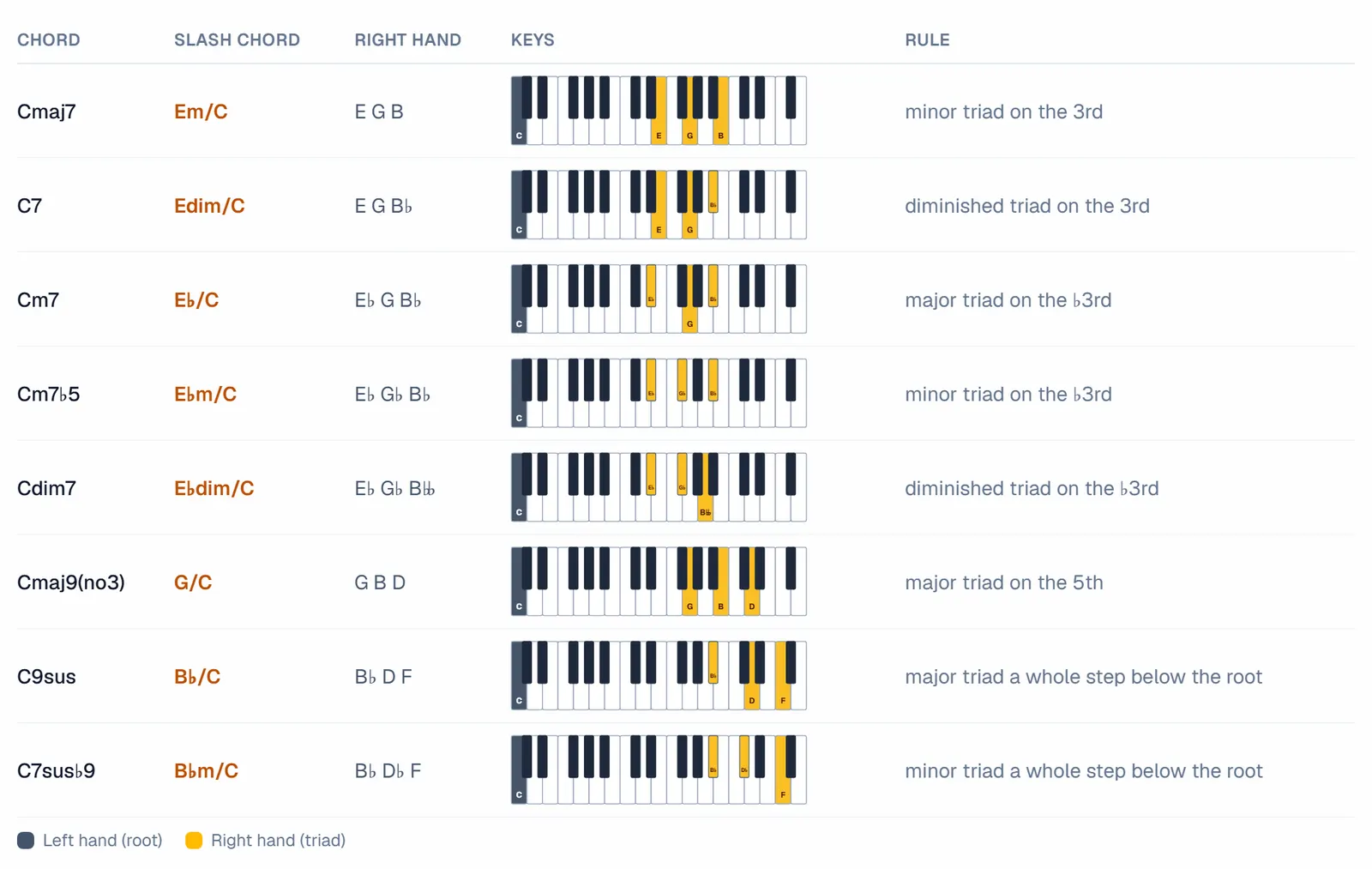
The rule depends on the chord type, but it's always a triad built on the 3rd of the chord:
| Chord | Slash chord | Right hand | Rule |
|---|---|---|---|
| Cmaj7 | Em/C | E – G – B | minor triad on the 3rd |
| C7 | Edim/C | E – G – B♭ | diminished triad on the 3rd |
| Cm7 | E♭/C | E♭ – G – B♭ | major triad on the ♭3rd |
| Cm7♭5 (Cø7) | E♭m/C | E♭ – G♭ – B♭ | minor triad on the ♭3rd |
| Cdim7 (C°7) | E♭dim/C | E♭ – G♭ – B𝄫 | diminished triad on the ♭3rd |
Two shortcuts make this stick:
- Major-type chords (maj7, 7) start the triad on the major 3rd; minor-type chords (m7, m7♭5, dim7) on the minor 3rd.
- The triad's quality is "one step darker" or "one step brighter" than you'd guess. A major 7 chord hides a minor triad; a minor 7 chord hides a major triad. Say it out loud a few times: "maj7 → minor on the 3rd, m7 → major on the ♭3rd".
Beyond 7ths: Triads on the 5th and the ♭7
Move the triad higher and you get richer chords with the same two-hand idea:
| Chord | Slash chord | Right hand | Rule |
|---|---|---|---|
| Cmaj9(no3) | G/C | G – B – D | major triad on the 5th |
| C9sus | B♭/C | B♭ – D – F | major triad a whole step below the root |
| C7sus♭9 | B♭m/C | B♭ – D♭ – F | minor triad a whole step below the root |
B♭/C is the classic "sus" sound of fusion and gospel: a major triad a whole step below the bass. G/C is the airy maj9 colour you hear in ballads. Neither chord has a 3rd, so the left hand plays only the root (or root and 5th).
Slash Chords Through IV–iii–ii–I and ii–V–I
Here's where the method pays off. Write a progression as slash chords and look only at the right hand:
| Progression in C | Chords | Slash chords | Right-hand triads |
|---|---|---|---|
| IV–iii–ii–I | Fmaj7 – Em7 – Dm7 – Cmaj7 | Am/F – G/E – F/D – Em/C | Am → G → F → Em |
| ii–V–I | Dm7 – G7 – Cmaj7 | F/D – Bdim/G – Em/C | F → Bdim → Em |
| I–vi–ii–V | Cmaj7 – Am7 – Dm7 – G7 | Em/C – C/A – F/D – Bdim/G | Em → C → F → Bdim |
In IV–iii–ii–I the right hand simply steps down the scale — Am, G, F, Em — while the left hand steps down F, E, D, C. That's the descending progression behind countless J-pop and city-pop songs, and as slash chords it's two parallel lines. In a ii–V–I, the right-hand triads move by close inversions while the bass jumps in 4ths, so practise picking the nearest inversion each time.
If ii–V–I is new to you, start with the guide-tone idea in Shell Voicings for Piano — the 3rd and 7th that shells keep are exactly the outer notes of these upper triads.
How to Use the Slash Chord Trainer
Open the Slash Chord Trainer.
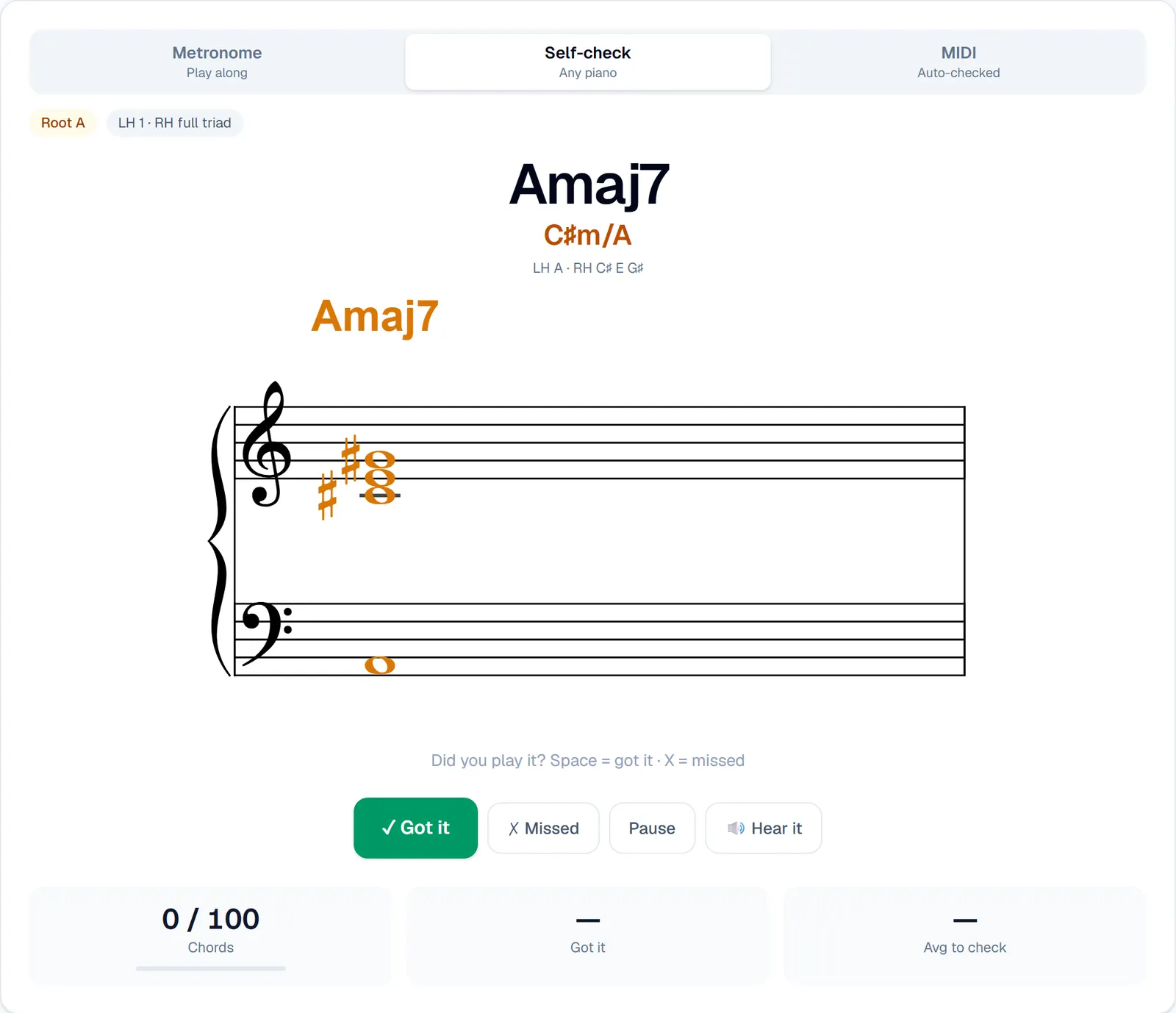
- Pick a mode. Metronome plays along and shows the slash name and notes on each chord's last beat. Self-check works on any piano: play the chord, press Space to check, then mark got it or missed (X). MIDI (Chrome / Edge) checks what you play automatically and times your reaction.
- Choose the content. Single chords drills each root through every chord type you select before moving on. Progression plays IV–iii–ii–I, ii–V–I or I–vi–ii–V in a major key.
- Select chord types. Tick any of Triad on the 3rd (maj7, 7, m7, m7♭5, dim7), Triad on the 5th (maj9 no3) and Triad on the ♭7 (sus). Start with maj7 and m7 only.
- Set the hands. Left hand: 1 (root, an octave is fine), 1–3 (root + 3rd, drawn as a 10th when it fits), 1–5 or 1–7. Right hand: Full triad, or Remaining notes — only the triad notes the left hand hasn't already played.
- Set the key order. The trainer starts in today's key from your practice plan. Up in 4ths (C, F, B♭, E♭…) runs through all 12 keys; Stay on one key repeats one.
- Watch your stats. First-try rate and average reaction time update as you play; every session is saved locally and shows up on the Dashboard.
Prefer jazz symbols? Switch Symbols to Jazz to see CΔ7, C-7, Cø7 and C°7 instead.
A 7-Day Practice Plan
| Day | Content | Settings |
|---|---|---|
| 1 | Single chords: maj7, m7 | Self-check, LH 1, Full triad, today's key |
| 2 | Add 7 (dominant) | Self-check, Up in 4ths |
| 3 | IV–iii–ii–I | Metronome, 4 beats per chord |
| 4 | ii–V–I | Metronome, LH 1–5 |
| 5 | Add m7♭5 and dim7 | MIDI or Self-check, Up in 4ths |
| 6 | I–vi–ii–V | LH 1–7, Remaining notes |
| 7 | Sus and maj9(no3) chords | LH 1, all 12 keys |
Ten minutes a day is enough. The goal on day 7 is to see "Fmaj7" and hear "A minor over F" in your head before your hands move.
Common Mistakes
- Building the triad from the root. The triad starts on the 3rd, not the root. If you play C–E–G over C you've just doubled a C major triad.
- Mixing up the triad quality. maj7 → minor triad, m7 → major triad. If it sounds wrong, check this first.
- Playing the triad in one fixed inversion. Move to the nearest inversion between chords, especially in ii–V–I.
- A left hand that's too low and too thick. A 1–3 or 1–5 under E2 gets muddy. Keep the left hand around C2–C3 and the triad around middle C.
FAQ
What does a slash chord like Em/C mean?
Play an E minor triad (E–G–B) with C in the bass. Together the notes are C–E–G–B: a Cmaj7 chord.
Are slash chords the same as inversions?
Sometimes. G/B is just a G major triad in first inversion. But Em/C or B♭/C put a bass note under the triad that isn't one of its notes, creating a different, larger chord — that's the use this trainer drills.
Is Am7 the same as C6?
They contain the same four notes (A–C–E–G), which is why Am7 can be written C/A. Which name is right depends on the bass note and the progression.
Are slash chords the same as upper-structure triads?
They're the same idea. In jazz, "upper structure" usually means a triad that adds tensions over a dominant chord's 3rd and 7th (for example D/C7 for C13♯11). Slash chords built on the 3rd are the simplest version, and a good first step towards those.
Start Practising
Once you see triads inside 7th chords, lead sheets get much easier to read. Open the free Slash Chord Trainer, start with maj7 and m7 in today's key, and add a chord type every couple of days. Then put the chords into a groove with the Piano Accompaniment Patterns trainer, or take the progressions through every key with the Chord Progression Trainer.