

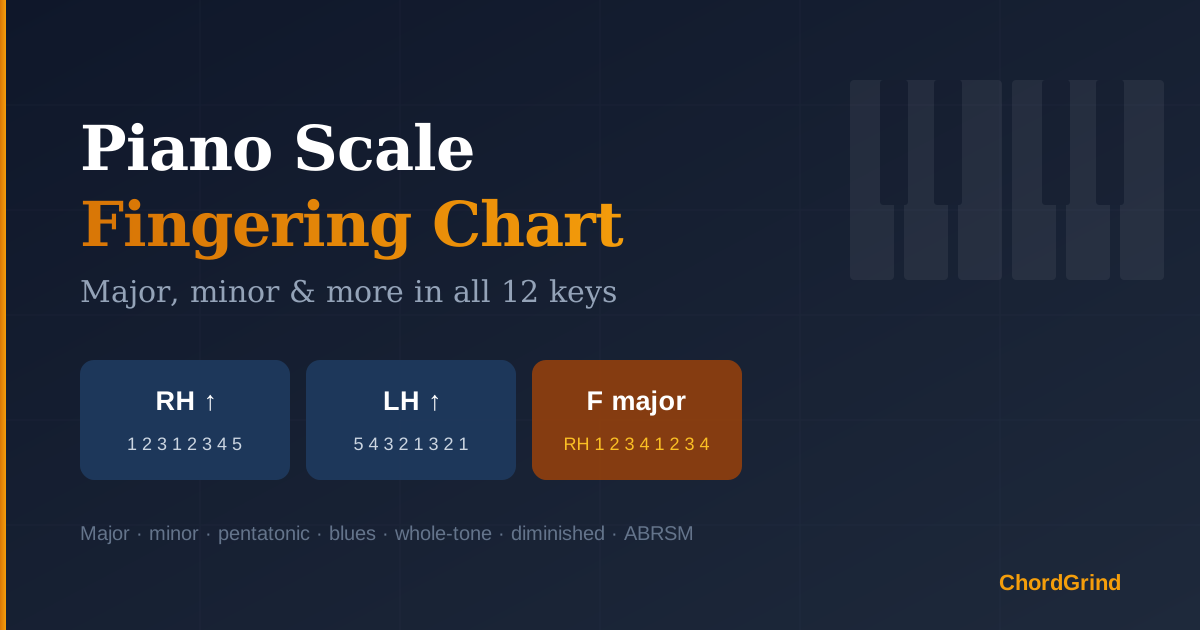
Bad fingering is the most common reason scales stay uneven. Use the right fingers and a scale becomes a smooth, repeatable motion; improvise them and every key feels different. This guide explains the logic behind standard piano scale fingering so you can remember it in any key, and shows you how to look up every scale on ChordGrind's free Piano Scale Fingering Charts.
Table of Contents
- Why Does Scale Fingering Matter?
- The Rules Behind Standard Fingering
- Which Scales Should You Learn?
- How to Use the Scale Fingering Charts
- A Daily Scale Routine
- Common Mistakes
- FAQ
Why Does Scale Fingering Matter?
A scale uses seven notes but you have five fingers, so the thumb has to pass under — or the hand has to cross over — at least once per octave. Good fingering puts those crossings where they're easiest: on white keys, right after a black key, so the hand never stretches awkwardly. Consistent fingering also means your hand learns one motion per scale, which is what makes scales fast and even.
The Rules Behind Standard Fingering
The charts follow the ABRSM standard used by most teachers and exams. A few rules explain almost all of it:
- C major family (C, G, D, A, E): right hand 1-2-3-1-2-3-4-5, left hand 5-4-3-2-1-3-2-1 for one octave.
- The thumb avoids black keys. In keys with many flats or sharps (D♭, G♭, B), the thumb plays only the white keys.
- Groups of 3 and 4. Fingers 1-2-3 and 1-2-3-4 alternate; the 4th finger lands once per octave, which is the easiest way to check you're right.
- Hands mirror each other in C major: the right hand's ascending fingering is the left hand's descending one.
| Scale | Right hand ↑ | Left hand ↑ |
|---|---|---|
| C major | 1 2 3 1 2 3 4 5 | 5 4 3 2 1 3 2 1 |
| G major | 1 2 3 1 2 3 4 5 | 5 4 3 2 1 3 2 1 |
| F major | 1 2 3 4 1 2 3 4 | 5 4 3 2 1 3 2 1 |
F major is the classic exception: the right hand's 4th finger plays B♭ so the thumb can land on C.
Which Scales Should You Learn?
- Major in all 12 keys.
- Minor — natural, harmonic and melodic.
- Pentatonic — major and minor; the backbone of pop, rock and blues improvisation.
- Blues — the minor pentatonic plus the ♭5 "blue note".
- Symmetric scales — whole-tone and diminished, for jazz and film colours.
How to Use the Scale Fingering Charts
Open the Piano Scale Fingering Charts.
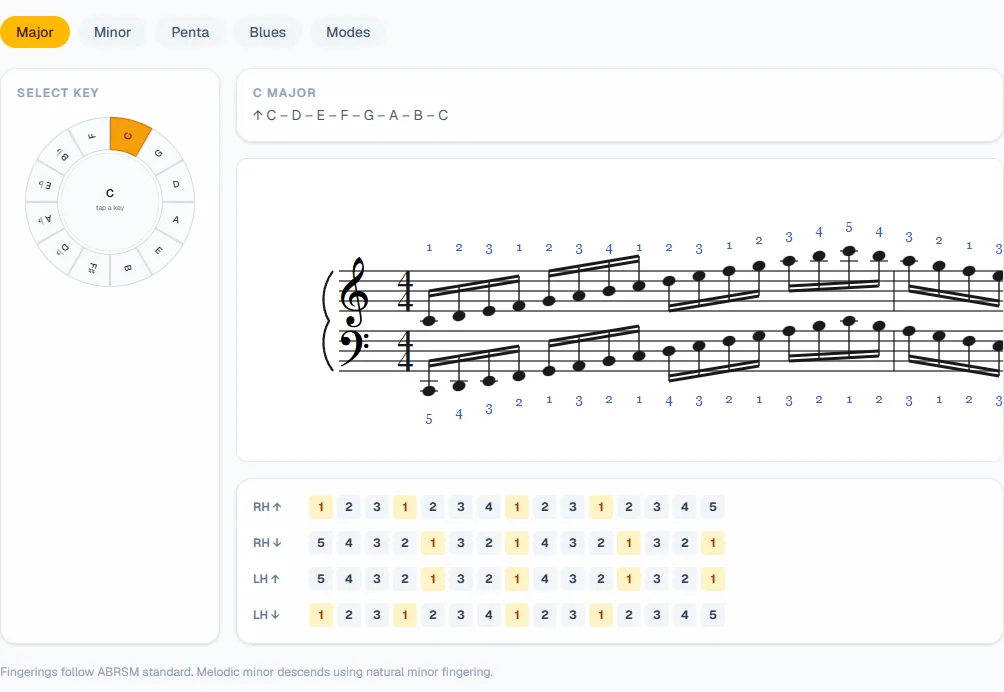
- Pick the scale type. Tabs across the top: Major, Minor (natural, harmonic, melodic), Penta (major and minor pentatonic), Blues and Modes (whole-tone and diminished).
- Pick the key. Tap a key on the wheel — it's laid out like the circle of fifths, so neighbouring keys share most of their notes.
- Read the grand staff. Two octaves for both hands, with finger numbers above (right hand) and below (left hand).
- Check the fingering table. RH ↑, RH ↓, LH ↑ and LH ↓ list every finger in order, with the thumbs highlighted — those are the crossing points to watch.
- Remember the melodic minor rule. Melodic minor ascends with its raised 6th and 7th and descends as natural minor, using the natural-minor fingering on the way down.
A Daily Scale Routine
Ten minutes, rotating through keys:
| Minutes | What | How |
|---|---|---|
| 2 | Today's major scale | Hands separately, slowly, watching the thumb crossings |
| 3 | Same scale, hands together | Two octaves, metronome at a comfortable tempo |
| 3 | Its relative minor (harmonic) | Hands separately, then together |
| 2 | Pentatonic or blues in the same key | Use it to improvise a short phrase |
Follow the circle of fifths — C, G, D, A… — so each new scale adds one sharp, or follow today's key in your practice plan.
Common Mistakes
- Thumb on a black key. If your thumb lands on a black key in a major scale, the fingering is almost certainly wrong.
- Changing fingering between practice sessions. Pick the standard fingering and stick to it until it's automatic.
- Practising too fast. Speed comes from evenness. Raise the tempo only when every note is equal.
- Skipping the left hand. It's usually weaker; give it extra hands-separate time.
FAQ
Is there one fingering that works for every major scale?
No, but most follow the same pattern of 1-2-3 and 1-2-3-4 groups. The differences come from where the black keys fall, which is why the thumb rule (no thumbs on black keys) matters.
What fingering standard do the charts use?
ABRSM, the standard used by most piano teachers and graded exams.
Should I learn pentatonic and blues scales?
Yes, especially if you play pop, rock, blues or jazz. They're the fastest way to start improvising, and their fingerings are short and comfortable.
Start Practising
Scales are your daily warm-up and the foundation for everything from chords to improvisation. Open the free Piano Scale Fingering Charts, learn one key a day around the circle of fifths, and keep the fingering identical every time. When the scales are comfortable, train your ears on the 7 modes.