

Knowing that Dorian is "minor with a raised 6th" is useful. Hearing it — recognising that bright, hopeful minor colour in a song without looking at a note — is what makes modes musical. This guide explains what makes each of the seven modes sound the way it does, and how to train your ears with ChordGrind's free Mode Ear Trainer.
Table of Contents
- Why Train Modes by Ear?
- Bright to Dark: How the 7 Modes Sound
- The Characteristic Note of Each Mode
- How to Use the Mode Ear Trainer
- A 3-Week Ear-Training Plan
- Tips for Hearing the Difference
- FAQ
Why Train Modes by Ear?
Modes show up everywhere: Dorian in funk and jazz, Mixolydian in rock and blues, Lydian in film scores, Phrygian in flamenco and metal. When you can hear a mode, you know which notes to improvise with, which chords will fit, and how a melody is going to move — without reaching for theory first.
If you still need to build the modes on the keyboard, read How to Memorize Piano Modes: The 2-Anchor System first. This guide is about recognising them.
Bright to Dark: How the 7 Modes Sound
The trainer orders the modes from brightest to darkest, which is also the easiest way to hear them:
| Mode | Built like | Sound |
|---|---|---|
| Lydian | Major with ♯4 | Brightest — floating, dreamy |
| Ionian | Major scale | Bright, resolved |
| Mixolydian | Major with ♭7 | Bright but bluesy, relaxed |
| Dorian | Minor with ♮6 | Minor but hopeful, soulful |
| Aeolian | Natural minor | Sad, serious |
| Phrygian | Minor with ♭2 | Dark, Spanish-sounding |
| Locrian | Minor with ♭2 and ♭5 | Darkest, unstable |
The first three are major-family modes (major 3rd); the last four are minor-family (minor 3rd). Deciding major or minor first halves the problem.
The Characteristic Note of Each Mode
Each mode has one note that sets it apart from plain major or minor — its characteristic interval:
- Lydian — the raised 4th (♯4) against major.
- Mixolydian — the lowered 7th (♭7) against major.
- Dorian — the natural 6th against minor.
- Phrygian — the lowered 2nd (♭2) against minor.
- Locrian — the lowered 5th (♭5).
Listen for that one note and the mode usually reveals itself.
How to Use the Mode Ear Trainer
Open the Mode Ear Trainer and expand Practice Settings.
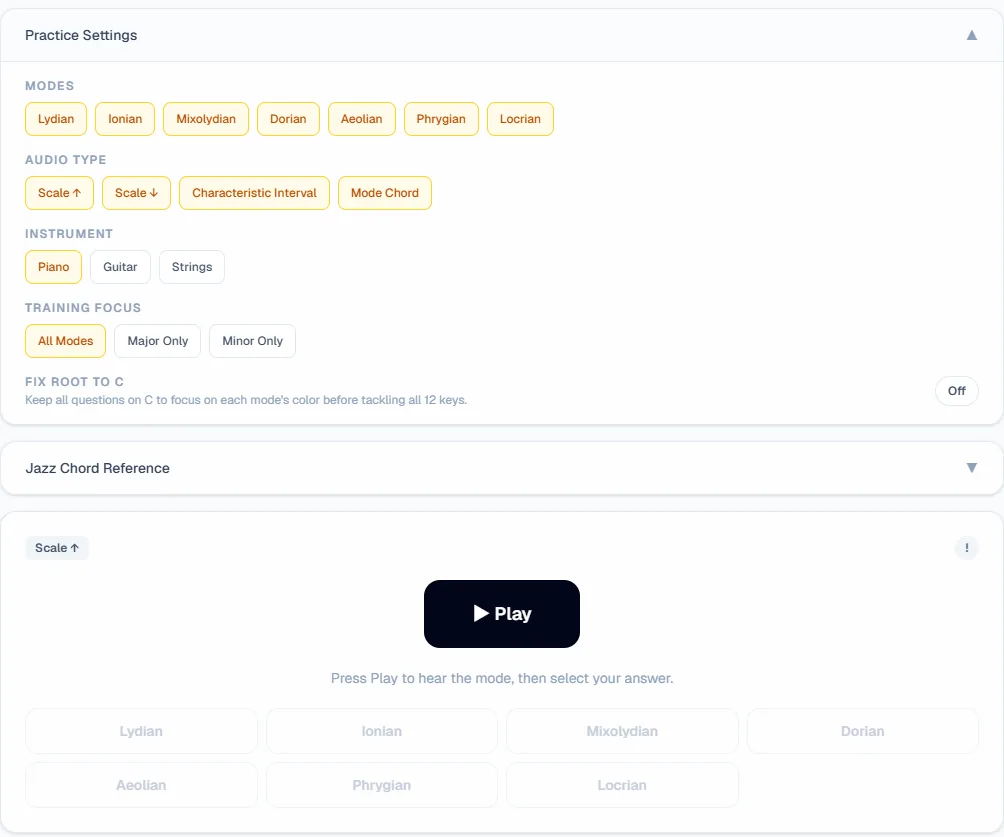
- Choose the modes. Start with two or three — for example Ionian, Mixolydian and Dorian — and add more as you improve.
- Choose the audio types. Scale ↑ and Scale ↓ play the whole mode; Characteristic Interval plays the one interval that defines it; Mode Chord plays the chord built on the mode. Mixing them trains you to recognise the mode in different musical contexts.
- Pick an instrument. Piano, guitar or strings.
- Set a training focus. All Modes, Major Only (Lydian · Ionian · Mixolydian) or Minor Only (Dorian · Aeolian · Phrygian · Locrian).
- Fix Root to C while you learn. Keeping every question on C lets you focus on each mode's colour before tackling all 12 keys.
- Press ▶ Play, then answer. Pick the mode you heard from the seven buttons. Your accuracy for this session and all time is tracked, and Jazz Chord Reference shows which chord each mode fits over.
A 3-Week Ear-Training Plan
| Week | Modes | Settings |
|---|---|---|
| 1 | Ionian, Aeolian, then add Mixolydian and Dorian | Scale ↑, Fix Root to C |
| 2 | All major-family, then all minor-family | Add Characteristic Interval, Major Only / Minor Only |
| 3 | All seven | All audio types, root free (all 12 keys) |
Five to ten minutes a day is better than one long session a week — ears improve with frequent, short exposure.
Tips for Hearing the Difference
- Major or minor first. Listen to the 3rd before anything else.
- Then the "odd" note. Find the characteristic note — the ♯4, ♭7, natural 6 or ♭2.
- Sing it back. Humming the scale after hearing it locks the sound in.
- Connect it to songs. Mixolydian is the sound of many rock riffs; Dorian of many funk and jazz grooves. A song you know is the best memory hook.
FAQ
What's the easiest mode to hear?
After major (Ionian) and natural minor (Aeolian), Mixolydian and Dorian are usually the easiest because they differ from major and minor by just one note.
Why is Locrian so hard to recognise?
Its ♭5 makes the tonic chord diminished, so it never sounds settled. It's rare in music, so start without it and add it last.
Do I need to know music theory to use the trainer?
No. You can learn the modes purely by sound — the theory just helps you explain what you're hearing.
Start Training Your Ears
Modes stop being abstract the day you can hear them. Open the free Mode Ear Trainer, start with two modes on a fixed root, and add one at a time. Then play them under your fingers with the scale fingering charts.