

Been drilling modal scales lately and started writing down my own system for keeping track of them across all 12 keys. What started as practice notes turned into the method below.
Here's a scenario most pianists know: you understand modes theoretically, but the moment you sit down to actually play one, your brain goes blank. You start calculating intervals from scratch, lose your place, and by the time you've worked it out, the musical moment has passed.
You're not alone — and the problem isn't your memory. It's the method.
The Two Popular Approaches — and Where They Fall Short
Most players learn modes through one of two well-known methods. Both work. Both have real limitations.
Method 1: The Single-Anchor / Parallel Method
This approach treats the major scale as the one universal reference point. Every mode is memorized as a set of alterations from that single anchor:
- Dorian = major with ♭3 and ♭7
- Mixolydian = major with ♭7
- Phrygian = major with ♭2, ♭3, ♭6, ♭7
- Lydian = major with ♯4
The theory is clean and internally consistent. The drawback surfaces in real playing: you still have to run a mental calculation every time. Getting to Phrygian requires remembering four separate alterations from major. Under time pressure at the keyboard, that's four chances to miscalculate.
Method 2: The Relative Key Method
This approach works from parent keys instead of alterations. Want to play F Dorian? Find F Dorian's parent key (E♭ major), then play E♭ major starting on F. You only need to hold major-scale fingerings in your memory — everything else is a reframe of the start point.
This is the most widely taught introductory method, and for good reason: it's clean in theory and works well for modes that sit close to the major scale. The limitation is the lookup step. "What's the parent key of B Mixolydian?" requires a mental calculation before you've played a single note.
A Third Way: The 2-Anchor Hybrid
The 2-anchor system borrows the best of both methods and sidesteps the worst of each.
From Method 1, it takes the idea of small alterations — but instead of deriving everything from one anchor, it splits the work across two. Modes that feel "bright" (Lydian, Mixolydian, Locrian) derive from the major scale. Modes that feel "dark" (Dorian, Phrygian) derive from the natural minor scale. This halves the maximum number of alterations you ever need to calculate.
From Method 2, it borrows the Locrian shortcut: instead of memorizing six alterations from major, you simply go up one semitone and reframe the start point — exactly the relative-key logic, but applied to the one mode where it saves the most mental work.
The result: two deep anchor scales, five small adjustments, one shortcut trick. No seven-scale memorization required.
The Two Anchors You Already Know
The system only works when both anchors are truly automatic — no thinking, just playing.
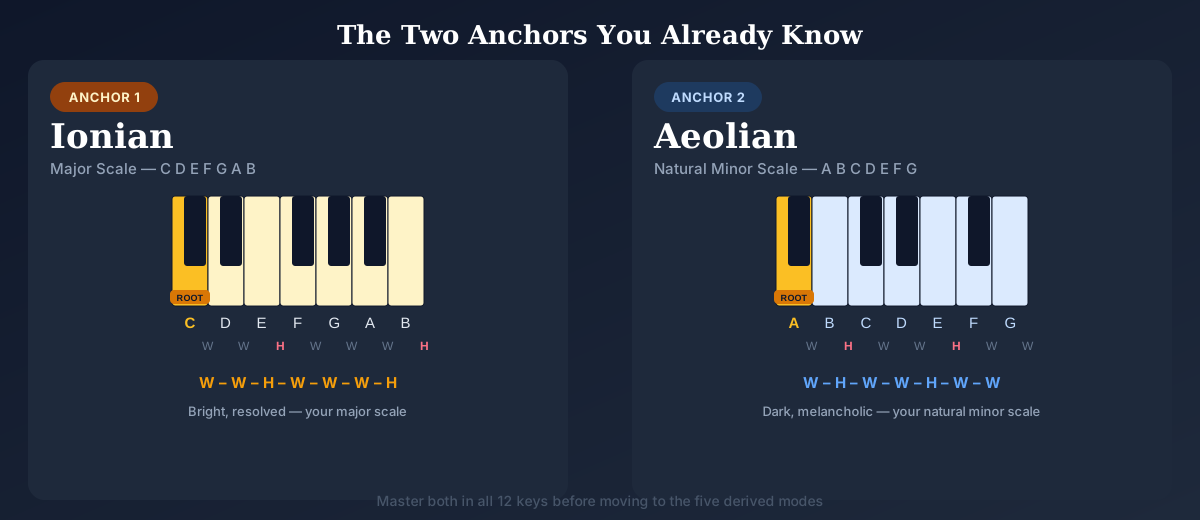
Anchor 1: Ionian (Major Scale) — If you can play a major scale in all 12 keys fluently, you have your first anchor. The interval pattern W–W–H–W–W–W–H is the foundation for three derived modes.
Anchor 2: Aeolian (Natural Minor Scale) — Natural minor is your second anchor. Its interval pattern W–H–W–W–H–W–W provides the foundation for two more modes.
Note that both scales use only white keys in their natural forms (C major and A natural minor). What changes is the root note and the pattern of whole steps and half steps — the interval structure you can see highlighted above.
Once both anchors are automatic in all 12 keys, the rest of the modes become simple one-note adjustments.
Group 1: Three Modes Derived from Ionian
Lydian: Raise the 4th
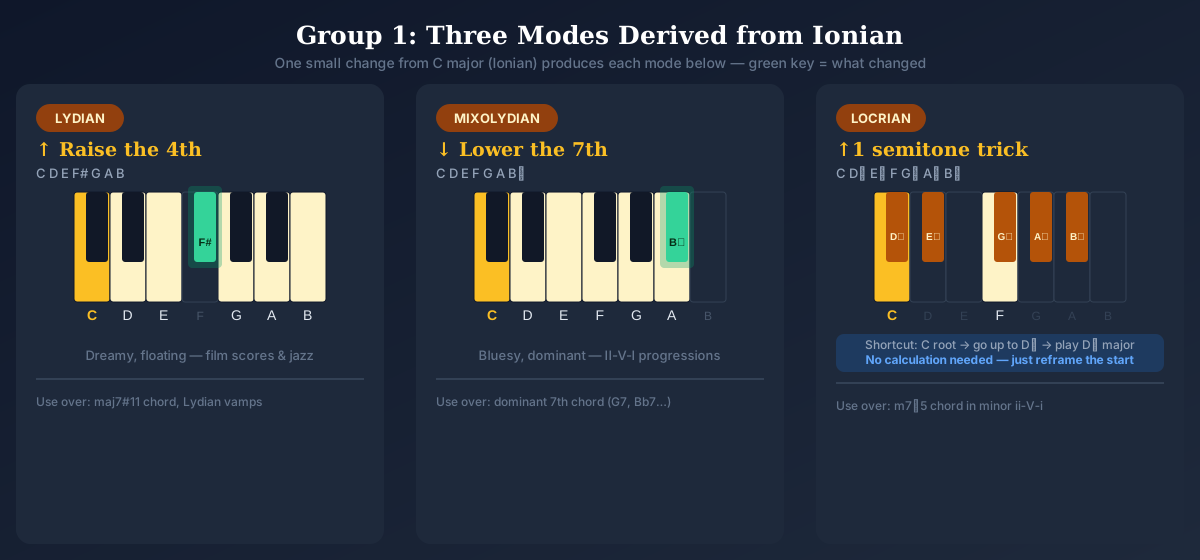
Play your major scale, but raise the 4th degree by one semitone. In C: C D E F# G A B. The raised 4th gives Lydian its dreamy, floating quality — common in film scores and modern jazz over maj7♯11 chords.
Mixolydian: Lower the 7th
Play your major scale, but lower the 7th degree by one semitone. In C: C D E F G A B♭. Mixolydian is the scale of dominant 7th chords — you will use it constantly in jazz over any dominant chord in a ii–V–I.
Locrian: The Semitone Shortcut
Locrian is where pure alteration-counting gets expensive — six changes from major. Instead, borrow the relative key logic: find your root note, go up one semitone, and play that note's major scale from your original root.
In C Locrian: go up to D♭, then play D♭ major starting on C. You are not calculating the mode from scratch; you are reframing the starting point. This is the Method 2 shortcut applied exactly where it saves the most mental effort.
Group 2: Two Modes Derived from Aeolian
Dorian: Raise the 6th
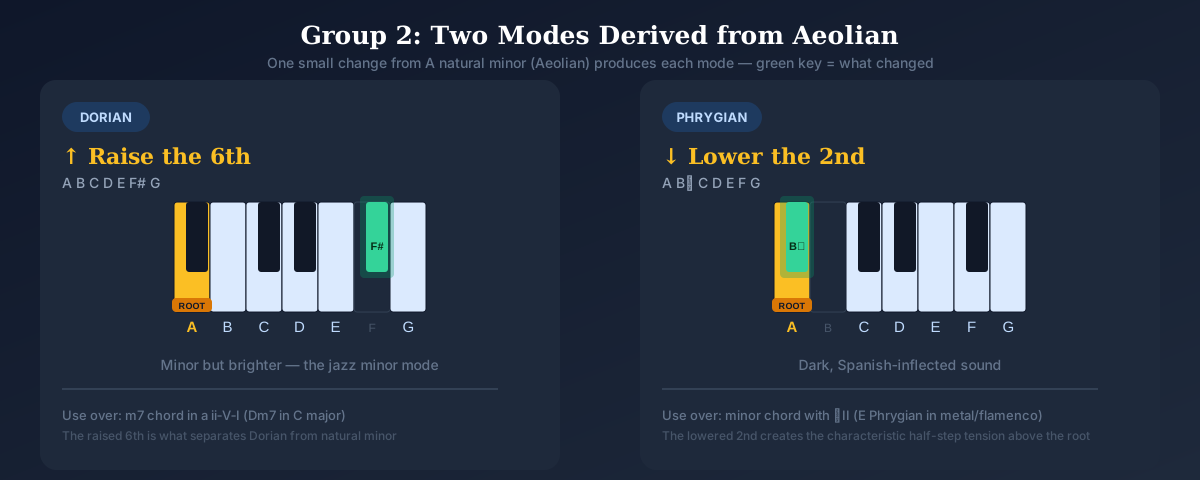
Play your natural minor scale, but raise the 6th degree by one semitone. In A: A B C D E F# G. Dorian is arguably the most important mode in jazz — it is the scale for minor 7th chords in a ii–V–I progression. The raised 6th is the single detail that separates Dorian from natural minor and gives it a brighter, less melancholic character.
Phrygian: Lower the 2nd
Play your natural minor scale, but lower the 2nd degree by one semitone. In A: A B♭ C D E F G. The lowered 2nd creates Phrygian's characteristic dark, Spanish-inflected sound. One half-step change from Aeolian produces a completely different mood.
Why Two Anchors Beat One
Some players work from the major scale alone, deriving every mode as a rotation. This works in theory but creates a bottleneck: all seven modes depend on your major scale fluency in every key. When that fluency wobbles in a key — and it always wobbles somewhere — all derived modes wobble with it.
The split also maps onto how modes actually function harmonically:
| Anchor | Modes | Harmonic color |
|---|---|---|
| Ionian | Lydian, Mixolydian, Locrian | Bright / dominant |
| Aeolian | Dorian, Phrygian | Dark / minor |
This grouping reinforces musical intuition. When you are in a minor context and need Dorian, you reach for the minor anchor. When you are in a dominant context and need Mixolydian, you reach for the major anchor. The two-anchor structure matches how you already hear harmony.
How to Practice This System
Step 1. Make Ionian and Aeolian automatic in all 12 keys. Non-negotiable — the system only works when both anchors require zero conscious effort.
Step 2. In one key (start with C and A), practice each adjustment one at a time. Do not move to the next mode until the current one is fluent.
Step 3. Cycle through all 12 keys, starting with the keys where your anchors are weakest. Target Gb, B, and Ab specifically — those are where most players have gaps.
Step 4. Connect each mode to its chord voicings. Use ChordGrind to drill the chord shapes that go with each mode — hearing the sound of the chord reinforces the modal formula faster than any scale exercise.
FAQ
What's the easiest mode to learn first after major and minor?
Dorian. It is only one note different from natural minor (the raised 6th), and it appears in nearly every jazz standard over minor 7th chords. Start here and you immediately have something musical to use.
Do I need all 7 modes to play jazz?
The most essential three are Dorian (minor chords), Mixolydian (dominant 7th chords), and Ionian (major 7th chords). Those cover most jazz standards. Lydian, Phrygian, and Locrian deepen your vocabulary but are not prerequisites.
Is Locrian actually used in jazz?
Rarely, but it matters. The half-diminished chord (m7♭5) in a minor ii–V–i is built on Locrian. Knowing the semitone shortcut — go up one half step and play that major scale — means you are never stuck when it appears.
How long does it take to get modes fluent in all 12 keys?
With focused daily practice (20–30 minutes), most pianists reach comfort with all 7 modes in all 12 keys within 3–6 months. The two-anchor system shortens that timeline because you are building on patterns you already own.
What's the best way to hear the difference between modes?
Play them back-to-back over a sustained drone on the root note. The characteristic interval — the raised 4th in Lydian, the lowered 7th in Mixolydian — becomes immediately audible when compared directly against Ionian on the same root.
Start Practicing Today
Knowing the formulas is step one. The real work is getting each mode fluid in all 12 keys until the adjustments become automatic.
ChordGrind is a free, browser-based jazz chord practice tool — no sign-up, no download. Drill voicings across all chord types in every key, with a built-in metronome and audio playback. It is the fastest way to connect the modal theory above to actual sounds at the keyboard.